Translate

Showing posts with label Silence & attention. Show all posts

Tuesday, 21 January 2014

Creating expectation and other elements for atrezzo

The way in which you start a reading promotion session has an outstanding importance as the first impression the children get is going to have a huge impact on their attitude, attention, interest and general behaviour.
I, personally, haven't paid much attention to this in the past and I think it is one of my weakest points. However, there are a number of different things that you can use in order to create that sensation of thrill, of expectation that will give us our group's full attention, at least for a while.

For instance, one of our most famous local storytellers has a suitcase full of stories: La Maleta de Leocadio. This is a fairly simple element, but as children are used to have a storytelling session every time you use it, it fulfills its purpose really well.

Other things one might use is a decorated bag, a story box, a balloon piñata, crackers or any other similar elements. Sometimes those elements can serve you to form groups later on, like using different colours for the balloons, or placing different colour papers or numbers, or animals or whatever suits the activity in the cracker. This is an intelligent way of improving your time management.


In addition, one might use other kind of elements that, when used in a recurrent basis, allows the children to anticipate what is going to happen next. Among other elements we could go for a story hat, a story jacket, the story telling staff (as a magician cane), etc. Its strength is taken from the way you use it.

Finger puppets: They can be made with the children as a pre-activity, we can have them made ourselves or we can even paint a rudimentary one with a pen or fine marker on our fingers or thumbs. Even if you have your own, it is still a recommendable pre-activity as it allows the children to participate further later on.

Monday, 9 December 2013

Classroom English page


Like we have said before, classroom management is very important in order to perform a successful session with your class. Previously we have given a few tips and techniques which might be really useful to maintain silence and attention, to form groups quickly etc. However, as an EFL teachers we have to know the proper expressions for those actions and for other situations which might happen in your class. That's why today I'm showing you a very useful link which includes vocabulary and phrases related with the school/class environment.


Monday, 21 October 2013

Given the interest that you show for the topic I assume that you don't need any further explanation on the matter...

This is a technique used by one of my high school teachers when her class had been out of control too many times on a row. I have personally used it once with a 12 years old child and it has worked out very well. I am aware that it is an extreme technique that shouldn't be used but in certain situations and being aware that it might be counterproductive when used wrongly. It basically means that you reckon a certain unit or topic as finished (there might be an exam or not) given the interest the class is showing for it. For instance, my teacher use to start reading the paper at her desk and when there was a deep and tense silence all around she would state:; “Don't worry lads, you can keep on talking. We have plenty of time since it is not necessary to explain anything else on this unit”. What I think it makes it interesting is that makes people realize that it is nobody but themselves who is missing something. In case there is an exam (or even if there is no exam) it is important to make clear that this is no punishment of any kind but only the natural consequences of rejecting your teacher's help with a certain topic.

SHUT UP OR LOWER YOUR VOICE

It seems to be a good technique regardless of the age. However, there might be certain groups, especially of teenagers or people who are in the class against their will, in which it can fail. Fort those kind of groups it may be wiser to use a slightly more aggressive technique.

Friday, 11 October 2013

Classroom management resources

In this web-page you can find lots of different resources for classroom management, specially for primary school. It includes several timers, countdowns and clocks for time management as well as different resources for noise control, and other behavioural issues.

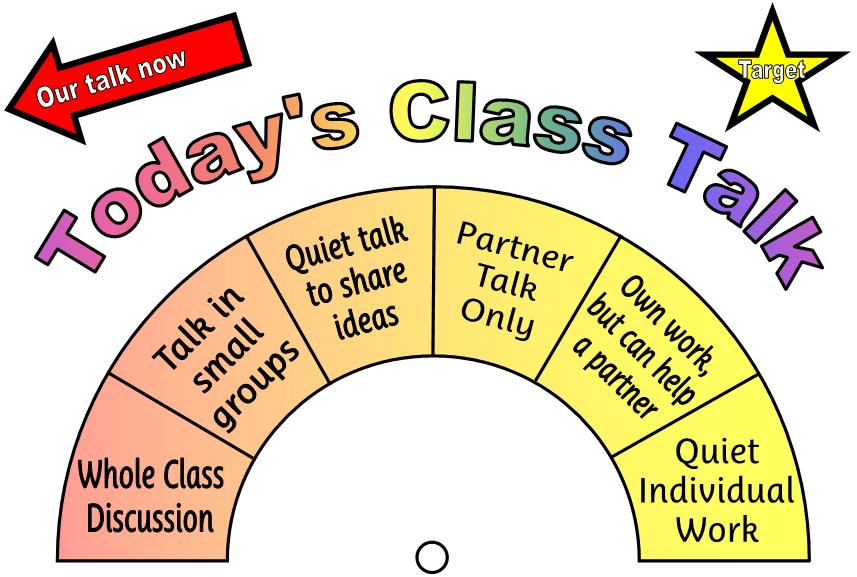
 Here is a nice resource to indicate children how the class is organized today and whether they are supposed to work individually, in pairs, altogether etc.
There are many examples of class rules too, though I personally think those rules work better when the children help to set them up themselves, as they feel more obliged to follow a rule they choose themselves.What's your own experience?

Wednesday, 9 October 2013

Ring a little bell or similar instrument

This is a technique one of my primary school teachers used to use in her class to demand silence and attention without wasting her voice. In my opinion it is less aggressive than a verbal warning, although at the end of the day it is pretty much the same thing. That is the reason why, after seen the previous technique I thought of some changes that might improve it: using the ring a signal for a previously arrange (and rehearsed if necessary) action such as saying ohmmmmmmmmmmmmmm all together while the bell is ringing just to bring everybody back to the thread of the class, or reciting a brief rhyme or even a multiplication table that we are trying to learn by heart.
I know from a friend who used to lecture at the university that those sudden changes work out very well with adults (specially when it involves some sort of joke or prank), as they create some expectation and therefore rise the attention levels. However, it might be a bit risky to do it with children without planning it very well as it might be difficult to have them focused back to the topic. What do YOU think?

Give me five!

Another usuful way of having silence and attention during your class. 

How does it work:
When there is too much noise the teacher says “give me five”, children rise their hands and everybody recites together “one, two, three, four, five” while they keep rising their fingers. And alternative way of doing it is calling “high five” and doing a countdown while we lower our fingers. Hopefully, you will have complete silence and attention at the end. 
It seems tome that this might be a  good resource for nursery school as well as for years 1 and 2 and even years 3 and 4. I don't think it could work out with older children, but I'm not completely sure about that. What do you think?

Clap (once, twice, three times ...) if you can hear me

This is a resource our teacher uses in order to have silence when her 4th year university students behave like primary school children.

How does it work:
When there is too much noise and chitchat in your class you say:
-Clap once if you can hear me.
-Clap twice if you can hear me.
-Clap three times if you can hear me.
-Etc.
Usually after three or four times you will have every children's attention. 

I like it because it makes people who are not paying enough attention feel like they are actually missing something and focus back onto group activities. In addition, it has to be said that its character is proactive and does not imply any punishment or authoritarian behaviour. What do you think?