
The purpose of this blog is to host a compilation of different texts and activities which can be used for an EFL class, as well as general resources. During the following weeks I'll post regularly different resources learnt at uni as well as other things I’ve seen as a student or within less formal environments, and hopefully I’ll do it both in Spanish and in English. In addition there will be useful links to other blogs and compilations.
Showing posts with label Year 5-6. Show all posts
Showing posts with label Year 5-6. Show all posts
Thursday, 14 June 2018


Wednesday, 9 May 2018
How can plants make their own food?
Plants, algae and some bacterias can make their own food. That means they do not have to eat other plants or animals to use their energy.
The following video explains how they do it.
And rememeber:
Photo=light (like in photography, photograph...)
Synthesis= Putting together.
The following video explains how they do it.
And rememeber:
Photo=light (like in photography, photograph...)
Synthesis= Putting together.
Wednesday, 21 March 2018
Saturday, 18 November 2017
The food pyramid
Os cuelgo una pirámide alternativa que está más actualizada.

Adapted from Harvard School of Public Health
Copyright © 2011, Harvard University. For more information about The Healthy Eating Plate, please see The Nutrition Source, Department of Nutrition, Harvard School of Public Health, www.thenutritionsource.org, and Harvard Health Publications, www.health.harvard.edu.
Healthy Weight
Y toda la colección de How the Body Works

Adapted from Harvard School of Public Health
Copyright © 2011, Harvard University. For more information about The Healthy Eating Plate, please see The Nutrition Source, Department of Nutrition, Harvard School of Public Health, www.thenutritionsource.org, and Harvard Health Publications, www.health.harvard.edu.
Healthy Weight
Y toda la colección de How the Body Works
Different foods, different nutrients
Remember:
NUTRIENTS
are SMALL
SUBSTANCES in FOOD.
They GIVE
us ENERGY,
MATERIALS
and VITAMINS
and MINERALS.
NUTRIENTS
|
WHAT
DO THEY DO?
|
| Proteins | They give us materials to grow and repair the body |
| Vitamins and minerals | They help the body work. |
| Carbohydrates | They give us energy |
| Fats | They give us energy |
| Fibre | It helps intestines work |
| Water | It helps the body work. |
And remember: we also need fibre and water to stay healthy.
Thursday, 11 September 2014
Further ICT resources
Today I've hung a few ICT resources that the teachers of St. Mary's university (London) recommended me as a really good way to help shy children to speak. Most of them consist on some sort of digital puppets you can make talk.
The teacher's criteria to choose the apps are:
-It must be easy to use.
-It must be easy to share.
-It must be free (not having to pay for it).
I would , personally, add two more criteria:
-It has to be free (as in free software) if possible.
-It has to run in as many platforms as possible.
Unfortunately, many of the apps that they recommended are for Apple (ipad/iphone mainly) though not all of them.
GO TO THE ICT RESOURCES SECTION AND SEE THEIR MAIN FEATURES AND WHERE TO DOWNLOAD THEM.
The teacher's criteria to choose the apps are:
-It must be easy to use.
-It must be easy to share.
-It must be free (not having to pay for it).
I would , personally, add two more criteria:
-It has to be free (as in free software) if possible.
-It has to run in as many platforms as possible.
Unfortunately, many of the apps that they recommended are for Apple (ipad/iphone mainly) though not all of them.
GO TO THE ICT RESOURCES SECTION AND SEE THEIR MAIN FEATURES AND WHERE TO DOWNLOAD THEM.
Monday, 14 July 2014
Idioms and proverbs II
As I promised, here you have a few more examples of how not to translate idioms into a different language.
http://www.experiensense.com/lost-in-translation/
http://blogs.publico.es/strambotic/2014/07/the-painful/

Enjoy.
http://www.experiensense.com/lost-in-translation/
http://blogs.publico.es/strambotic/2014/07/the-painful/

Enjoy.
Monday, 17 March 2014
Nursery rhymes at the Natural History Museum
Nursery rhymes can be useful for developing a cross curricular approach too!!
Last week, while visiting the Natural History Museum, I found a new version of Itsy Bitsy (or Eensy Weensy) Spider in which the kids can learn to appreciate their beneficial role within a house environment.
Here you have the original version of the song (one of them)
And here the Natural History Museum's cover.

In case you cannot read it properly, here is the whole lyrics:
Last week, while visiting the Natural History Museum, I found a new version of Itsy Bitsy (or Eensy Weensy) Spider in which the kids can learn to appreciate their beneficial role within a house environment.
Here you have the original version of the song (one of them)
And here the Natural History Museum's cover.
In case you cannot read it properly, here is the whole lyrics:
Insy-winsy spider didn't climb up the spout
She fell into the sink, now she can't climb out
If a thougtful person were to set this spider free
She would catch more household pests -and eat them eagerly.
Friday, 7 March 2014
Idioms and proverbs
A really good thing to do with your class, specially with the higher levels, is to show them some idioms, their translation to your own language and a brief explanation of why those idioms have that meaning. In my opinion, that helps to fade out the idea that languages admit direct translation out of context. The people from unadocenade.com have made a nice compilation of them in the following link.
Some hilarious examples of the opposite, such as the expression "from lost to the river" (and many others that you can find in the homonym book series), might be helpful (if used right) to create awareness on the uselessness of out-of-context-direct-translations.
I'll publish soon a few good examples. For now you can have thought on this translation that I found in a restaurant menu (I swear I'm not making it up): Pulpo/polbo a feira = Octopus on a party.
Would you actually know what are you ordering if you were an English speaker?
Would you order it at all if you don't know what is it?
Some hilarious examples of the opposite, such as the expression "from lost to the river" (and many others that you can find in the homonym book series), might be helpful (if used right) to create awareness on the uselessness of out-of-context-direct-translations.
I'll publish soon a few good examples. For now you can have thought on this translation that I found in a restaurant menu (I swear I'm not making it up): Pulpo/polbo a feira = Octopus on a party.
Would you actually know what are you ordering if you were an English speaker?
Would you order it at all if you don't know what is it?
Friday, 28 February 2014
English schools
I am participating in an exchange program between Spanish and English students so I can get to know the English educative system. So far, the experience has been really good. I have seen how things can be done in a really different way (specially when you don't lack human and material resources). I will try to post regularly about my experiences here (obviously without telling you the name of the school or any other information, which is of course confidential). In addition, I'll try to post some photos (without children) so you can see how their classes look like.
So far, the most remarkable thing I've seen is that for this children (for most of them anyway) getting to read a book is a reward rather than a punishment. This is very telling of what is the result of a very well done jog in reading promotion. My most sincere compliments to the teachers, specially those in the first years, that managed to seed such love for books in the children, instead of making them hate them.
Wednesday, 22 January 2014
A BROKEN TELEPHONE
This
is a good pre/post-activity that can be easily adapted to nearly any story you
can think of. First of all, you have to divide your class in groups, 2
to 4 depending on the amount of pupils and the way you normally work
with your group. Here you have some tips for that. Once
it is done, choose a phrase which has something to do with the story,
e.g. "Goldilocks was very hungry and she walked into the kitchen". Tell
the phrase to the first person of each group so they can whisper it to
the next. The last student has to say it aloud. If he or she is right,
they would have won the round. After every round, the students who had
received the phrase from the teacher will have to go to the back of
their group, ensuring a proper rotation.
Its
main advantage is that, besides being an amusing game enjoyed both by
children and adults, it can be adapted to any level and background and
therefore it should be challenging and motivating without being
frustrating.
Dramatization of a story
It is an interesting technique as it makes the students work and
exchange information between them three times: firstly as they prepare it,
secondly as they do it and thirdly when they talk and reflect about what they
have just done. I think that this is an ageless activity, provided that any
sort of scenic fear or shame has not been already developed in the children.
Tuesday, 21 January 2014
Tongue twisters: she sell seahells...
Tongue twisters are another excellent activity to for a lively English class. They are an enjoyable way of improving phonetic awareness while having fun. This was the very first activity I created for this class based on the fairly well known tongue twister: She sells seashells on/by/at the seashore.
Firstly, we started forming a train and imitating its sound using the sounds we produce in English for S and SH. S-SH-SH-SH-SH S-SH-SH-SH-SH S-SH-SH-SH-SH S-SH-SH-SH-SH S-SH-SH-SH-SH
Once we gain familiarity with the sound we change to a different pattern, that of the tongue twister itself
SH-S-S-SH-S-SH SH-S-S-SH-S-SH SH-S-S-SH-S-SH SH-S-S-SH-S-SH.
After playing for a while with the sequence we are ready to attempt the tongue twister.

The following pictures can be used if we want to paint a few shells as a post-activity.

As a general consideration when using tongue twisters, we must try to make them challenging, but not frustrating. For instance, in the picture you have an extended version which is slightly more difficult and can be used once the children domain the previous one.
An example of progressive level in a tongue twister:
Easy
Three Swedish witches
watch three Swiss watches.
Which Swedish witch
watch which Swiss watch?
Medium
Three Swedish switched witches
watch three Swiss Swatch watches.
Which Swedish switched witch
watch which Swiss Swatch watch?
Hard
Three Swedish switched witches
watch three Swiss Swatch watch switches
Which Swedish switched witch
watch which Swiss Swatch watch switch?
And as a final thought: is this or or is this not a much nicer way of learning English phonetics?
If you liked it, the British council offers a selection of them to be used in your class.
And her you have a few more.
Firstly, we started forming a train and imitating its sound using the sounds we produce in English for S and SH. S-SH-SH-SH-SH S-SH-SH-SH-SH S-SH-SH-SH-SH S-SH-SH-SH-SH S-SH-SH-SH-SH
Once we gain familiarity with the sound we change to a different pattern, that of the tongue twister itself
SH-S-S-SH-S-SH SH-S-S-SH-S-SH SH-S-S-SH-S-SH SH-S-S-SH-S-SH.
After playing for a while with the sequence we are ready to attempt the tongue twister.
The following pictures can be used if we want to paint a few shells as a post-activity.
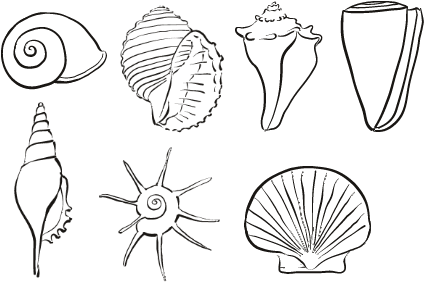
As a general consideration when using tongue twisters, we must try to make them challenging, but not frustrating. For instance, in the picture you have an extended version which is slightly more difficult and can be used once the children domain the previous one.
An example of progressive level in a tongue twister:
Easy
Three Swedish witches
watch three Swiss watches.
Which Swedish witch
watch which Swiss watch?
Medium
Three Swedish switched witches
watch three Swiss Swatch watches.
Which Swedish switched witch
watch which Swiss Swatch watch?
Hard
Three Swedish switched witches
watch three Swiss Swatch watch switches
Which Swedish switched witch
watch which Swiss Swatch watch switch?
And as a final thought: is this or or is this not a much nicer way of learning English phonetics?
If you liked it, the British council offers a selection of them to be used in your class.
And her you have a few more.
Monday, 20 January 2014
Nellie the elephant
This is not an
easy song, it has quite a few difficult words and structures and it might be a
bit too long for children at the first grades. Nevertheless we can teach them
the chorus (or the first two verses with the chorus) at the beginning and
subsequently teach them one verse at a time, always providing a context. I like
this song particularly for several reasons: First and foremost, it talks to the
children about an animal that does not want to be chained or showed in a circus
(which I think is an important lesson to learn). Secondly, the first two verses
and the chorus are not too difficult if a good context is provided (mimics,
silent drama, a video). Thirdly, it can be used year after year and when we
achieve the point when children are not interested in nursery rhymes anymore,
we can provide them with a punk cover by The Toy Dolls which many adults love
and which was indeed a great hit during 84's christmas.
To
Bombay
A travelling circus came
They brought an intelligent elephant
And Nellie was her name
One dark night
She slipped her iron chain
And off she ran to Hindustan
And was never seen again
A travelling circus came
They brought an intelligent elephant
And Nellie was her name
One dark night
She slipped her iron chain
And off she ran to Hindustan
And was never seen again
Ooooooooooooo...
Nellie
the Elephant packed her trunk
And said goodbye to the circus
Off she went with a trumpety-trump
Trump, trump, trump
Nellie the Elephant packed her trunk
And trundled back to the jungle
Off she went with a trumpety-trump
Trump, trump, trump
And said goodbye to the circus
Off she went with a trumpety-trump
Trump, trump, trump
Nellie the Elephant packed her trunk
And trundled back to the jungle
Off she went with a trumpety-trump
Trump, trump, trump
Night
by night
She danced to the circus band
When Nellie was leading the big parade
She looked so proud and grand
No more tricks
For Nellie to perform
They taught her how to take a bow
And she took the crowd by storm
She danced to the circus band
When Nellie was leading the big parade
She looked so proud and grand
No more tricks
For Nellie to perform
They taught her how to take a bow
And she took the crowd by storm
Ooooooooo
Nellie
the Elephant packed her trunk
And said goodbye to the circus
Off she went with a trumpety-trump
Trump, trump, trump
Nellie the Elephant packed her trunk
And trundled back to the jungle
Off she went with a trumpety-trump
Trump, trump, trump
And said goodbye to the circus
Off she went with a trumpety-trump
Trump, trump, trump
Nellie the Elephant packed her trunk
And trundled back to the jungle
Off she went with a trumpety-trump
Trump, trump, trump
The
head of the herd was calling
Far, far away
They met one night in the silver light
On the road to Mandalay
So Nellie the Elephant packed her trunk
And said goodbye to the circus
Off she went with a trumpety-trum
Trump, trump, trump
Far, far away
They met one night in the silver light
On the road to Mandalay
So Nellie the Elephant packed her trunk
And said goodbye to the circus
Off she went with a trumpety-trum
Trump, trump, trump
Ooooooooooooo...
Nellie
the Elephant packed her trunk
And said goodbye to the circus
Off she went with a trumpety-trump
Trump, trump, trump
Nellie the Elephant packed her trunk
And trundled back to the jungle
Off she went with a trumpety-trump
Trump, trump, trump
And said goodbye to the circus
Off she went with a trumpety-trump
Trump, trump, trump
Nellie the Elephant packed her trunk
And trundled back to the jungle
Off she went with a trumpety-trump
Trump, trump, trump
Using the song:
Like I said
before, I think a good way to introduce such a complex song will be to focus on
the first two verses and the chorus. To start with we will listen to the song
together with this video
to provide some context. Subsequently we will listen again, but adding some
mimics for the chorus (packing, saying good bye, the trumpety -trump etc.). We
can finish by making a small dramatization in which the first two verses are
performed.
In case we are
working with older people, we can continue by playing after a few times the Toy
Dolls cover in two different videos: one containing the lyrics
and the official
video.
Activities related with special days or dates:
Quite often we are able to use special days,
celebrations, the change of the season, etc. as a topic to link a sequence of
activities. The fact that we are talking about something that is happening here
and now makes it motivating and relevant to the children.
In our class we did several activities related to autumn such as:
Autumn rhymes
Autumn acrostic
poems
I must say I've never particularly enjoy this kind of activity. I find them as boring as I did as a child. However, there are several authors, such as Gianni Rodari, that recommend this kind of activity to promote creativity. This is a selection of what was written in class.

Halloween activity
The last one is the one I really liked here are a few tips to organize it:
1-Introduction and motivation:
Halloween
e-card.
In the following link you will find an amazing Halloween e-card. In addition, you here it is a compilation of pages that gives you tips both for digital and classic Halloween cards for children.
Pumpkins, candles and further atrezzo.
This kind of elements help you to create expectation. Use them for introduction and motivation and use them to link with the next activity by means of lighting them and asking for a spell.
You can create other elements to provide background such as magic potions (with soda powder, vinegar, a bit of soap and cupcakes colourant) which as you will see later on in the video can be used for amazing tricks that can be related with your science class.
2-Writing spells
Children have to write their
spells and hung them on a Poplet wall, for example:
Frog leg and owl feathers or
Wolf fang and skin of snakes
Cast a spell over this `potion
That will charm you anyway.
Later on you can put them all together like we did here.
3-Reading the spells aloud around the candles
while we watch the potions.
This is a good way to work things as stress, rhythm and other phonetic aspects of the language while doing something fun. The teacher might start reading aloud so the children are presented with a quality input to replicate and later on different groups or individual students will recite their own spells as well as their mates.
At the same time this works really well as a context for the following activities.
This is a good way to work things as stress, rhythm and other phonetic aspects of the language while doing something fun. The teacher might start reading aloud so the children are presented with a quality input to replicate and later on different groups or individual students will recite their own spells as well as their mates.
At the same time this works really well as a context for the following activities.
4- We finish up with the first chapter of Meg and Mog which is available as a normal video or with
texts to read.
There are many pre and post activities related to Meg and Mog available. Here it is what we prepared for the 4th grade children of La Salle.


MEG AND MOG
Ø
Activity
1: Brainstorming.
What do you know about witches?
1.
We
ask the children to say aloud words that they know about witches.
2.
We
draw a table on the blackboard and we organize the words in groups.
WITCH’S THINGS
|
WITCH’S PETS
|
WITCH’S BODY
|
WITCH’S CLOTHES
|
Cauldron
|
Frog
|
Wart
|
Hat
|
Broom
|
bat
|
3.
We
teach them to build a mind map with it by using a popplet.

Ø Activity 2: Introducing the characters.
We show the children the following flashcards and we ask them questions
about them.

JESS
|

TESS
|

CRESS
|

OWL
|

BESS
|

MEG
|

CAT
|
~
What is this? Is
it an animal? Is it a witch?
~
Is it a cat? Is
it an owl?
~
Is she Jess,
Tess, Cress, Bess or Meg?
~
Has she got a
frog? Has she got a spider? Has she got…?
Activity 3: Guess who.
1.
With
the questions we organize a ‘Guess who’ game in groups with the information
about the witches. It has the only purpose of teaching them how to play. To do
that we ask one group to leave the class. We choose one of the flashcards. When
the pupils come back into the class they have to make questions to guess the
flashcard that we are talking about.

2.
Once
they’ve learned how to play we start a new game using new questions and with
the pupils in the class
What’s she wearing?
Is she tall/ short?
Has she got long/short/ curly/straight hair?
 Activity 4: Reading.
  Video.
Now, in small groups the children have to take the
video home and record their voices as if they were the characters. http://www.youtube.com/watch?v=Ti_9JEHTZZs
Activity 5: A cauldron
party.
In a circle,
each student will have to say what she/ he is going to put in into the
cauldron.
‘As I’ve been
invited to this cauldron party, I’ve brought this_____ in case we get hungry
hahaha’ (flashcards with strange animals)

Activity 6: Role play.
There is a witch
in the village and she’s putting spells on the village people. We need to catch
the witch together before she puts everybody under her spell.
Characters: A director (the teacher), a witch and the rest are
the villagers.
Rules of
the game: We sit on a
circle and we deal a card to each player, one of the cards is the witch and the
rest are the villagers.
This is an amazing dynamic to practice
conversation. It allows children to speak to each other, as they have to decide
who the witch is in order to try and execute it.
Some of the structures they can practise
are:
‘I think that she is the witch because’... ‘She
spoke first’... ‘she didn’t speak...
‘She is the witch because’... ‘she moved’... ‘she
is silent’..
Once everyone has their card the
director (or teacher) will ask everybody to go to sleep, so everyone will look
down. Subsequently, the director will call the witch to wake up, put a spell on
a villager (by means of pointing or looking to its victim), and get back to
sleep. Then the villagers will wake up and the director will inform the victim
of his or her condition. Immediately after, people will speak against each
other for a few minutes- For instance Pedro may say: ‘I think that Manolo is
the witch because I saw him moving a little when the witch was cursing’. And
Pedro might reply: ‘I think the wolf is Pedro because he accused me first’.
After a while there will be a poll. Whoever is voted witch will be executed
(loses the game), and therefore will turn his or her card facing up. If it is
the witch (the real one,) the round is over and we shall assign new roles. If
the person chosen is a villager, the whole process will start again.
We can adapt the background of the
dynamic to whatever text we are working with. The characters could be animals,
villagers, courtier, or whatever suits us; in the same manner the witch could
be any antagonist that appears in our story.
And this is the video of what we finally did.
Many of my classmates did their activities base on Meg and Mog for different grades within the same school. Here there are a few videos on what they did.
I particularly like the one my mates did for nursery school children because despite having too far too many children for the activity they are performing, they successfully maintain their attention at all times while they manage to make them say the names of many ingredients.
On the other hand I must say I didn't like that much the final activity they did based on this one as I did not really grasped what the whole point was, besides making a brownie. In this sense, I have observed that too often (not this particular group, I'm talking in general) the input that we are offering the children is wrong (e.g. talking about a cooking receipt instead of a recipe) and that makes me wonder what is the use then. I mean that I might be doing and amusing activity in which the children are going to relate certain concepts with its representation in English verbal language through and input that we are providing. But if the input is not correct, the children are learning something wrong and we might be creating problems for the future.
Noah's Ark
Noah's Ark is ready to sail, but most animals run away last night. You have to find them as soon as possible. The team that finds them first will get a free ride in the Ark.

This is a really good post-activity to be used after a song or a story related to animals. It consists on writing animal names that the children may know (be careful to adapt it to their level so it is fun rather than frustrating) in small cards, divide them between two or more teams and allow them to describe the animals to their own team so they can guess which animal it is and go to the next. If somebody doesn't know the animal they have to describe they can skip their turn after placing that card in the last position.
This is an activity that can be adapted in many different ways:
-Normally you are not allowed to describe an animal by its sound or using not verbal language, however, this might be very recommendable when doing it with small children.
-If you do so, you might like to use pictures instead of cards with the names written on them (or both things).
-You might decide not to form teams in case you want to have a better control over the class as a whole.
-If the activity is based on description by verbal language a few posters that provide with the most essential vocabulary such as this one.

This is a really good post-activity to be used after a song or a story related to animals. It consists on writing animal names that the children may know (be careful to adapt it to their level so it is fun rather than frustrating) in small cards, divide them between two or more teams and allow them to describe the animals to their own team so they can guess which animal it is and go to the next. If somebody doesn't know the animal they have to describe they can skip their turn after placing that card in the last position.
This is an activity that can be adapted in many different ways:
-Normally you are not allowed to describe an animal by its sound or using not verbal language, however, this might be very recommendable when doing it with small children.
-If you do so, you might like to use pictures instead of cards with the names written on them (or both things).
-You might decide not to form teams in case you want to have a better control over the class as a whole.
-If the activity is based on description by verbal language a few posters that provide with the most essential vocabulary such as this one.
Monday, 9 December 2013
Classroom English page
Like we have said before, classroom
management is very important in order to perform a successful session
with your class. Previously we have given a few tips and techniques
which might be really useful to maintain silence and attention, to
form groups quickly etc. However, as an EFL teachers we have to know
the proper expressions for those actions and for other situations
which might happen in your class. That's why today I'm showing you a
very useful link which includes vocabulary and phrases related with
the school/class environment.
Tuesday, 22 October 2013
The runaway train
T'was in the year of
'89 on that old Great Western line,
When the winter wind was blowin' shrill,
The rails were froze, the wheels were cold, then the air brakes wouldn't hold,
And Number 9 came roaring down the hill -- oh!
When the winter wind was blowin' shrill,
The rails were froze, the wheels were cold, then the air brakes wouldn't hold,
And Number 9 came roaring down the hill -- oh!
The runaway train came
down the track and she blew,
The runaway train came down the track and she blew,
The runaway train came down the track, her whistle wide and her throttle back,
And she blew, blew, blew, blew, blew.
The runaway train came down the track and she blew,
The runaway train came down the track, her whistle wide and her throttle back,
And she blew, blew, blew, blew, blew.
The engineer said the
train must halt and she blew,
The engineer said the train must halt and she blew,
The engineer said the train must halt -- he said it was all the fireman's fault,
And she blew, blew, blew, blew, blew.
The engineer said the train must halt and she blew,
The engineer said the train must halt -- he said it was all the fireman's fault,
And she blew, blew, blew, blew, blew.
The fireman said he
rang the bell and she blew,
The fireman said he rang the bell and she blew,
The fireman said he rang the bell -- the engineer said "You did like h***!"
And she blew, blew, blew, blew, blew.
The fireman said he rang the bell and she blew,
The fireman said he rang the bell -- the engineer said "You did like h***!"
And she blew, blew, blew, blew, blew.
The porter got an awful
fright and she blew,
The porter got an awful fright and she blew,
The porter got an awful fright -- he got so scared he near turned white,
And she blew, blew, blew, blew, blew.
The porter got an awful fright and she blew,
The porter got an awful fright -- he got so scared he near turned white,
And she blew, blew, blew, blew, blew.
A donkey was standing
in the way and she blew,
A donkey was standing in the way and she blew,
A donkey was standing in the way and all they found was just his bray,
And she blew, blew, blew, blew, blew.
A donkey was standing in the way and she blew,
A donkey was standing in the way and all they found was just his bray,
And she blew, blew, blew, blew, blew.
The conductor said
there'd be a wreck and she blew,
The conductor said there'd be a wreck and she blew,
The conductor said there'd be a wreck and he felt the chills run up his neck,
And she blew, blew, blew, blew, blew.
The conductor said there'd be a wreck and she blew,
The conductor said there'd be a wreck and he felt the chills run up his neck,
And she blew, blew, blew, blew, blew.
The runaway train went
over the hill and she blew,
The runaway train went over the hill and she blew,
The runaway train went over the hill and the last we heard she was going still,
And she blew, blew, blew, blew, blew.
The runaway train went over the hill and she blew,
The runaway train went over the hill and the last we heard she was going still,
And she blew, blew, blew, blew, blew.
This song is far more difficult than
the previous ones so we can either save it for high grades or learn it
verse-by-verse (one a month or so, depending of the age and the level
of the children). Besides that, it would be a good idea to tell the
children what does the first verse mean in order to provide them with
an adequate context. On top of that, pictures, videos
or mimics can be used to provide further context.
Monday, 21 October 2013
Paper bags/secret object.
As well as the previous activity, this one is adequate either for
groups where people know each other for years. Alternatively, it can suit
groups that having met that very same year, have been doing a few presentation
activities for the last few days and know a little bit about each other.
Everyone has to choose a personal object (or put a previously agreed
number of them in a paper bag) and place it into the common box (not allowing
anyone to see whose object/bag is it). Subsequently, we will pick them
one-by-one and, altogether we will try to guess who the owner is.
Subscribe to:
Posts (Atom)